Beryxa · Independent Strategic Evaluations
Founders are rarely stuck for lack of ideas.
They are stuck because the decision hasn't been named clearly.
Beryxa provides independent written strategic evaluations for startup founders. You describe your situation. We identify the real problem, recommend the appropriate evaluation, and deliver a carefully written document that examines the decision underneath the work.
Not coaching. Not a retainer. Not generic startup advice. One important business problem, examined carefully, delivered as a document you can revisit for years.
You never have to diagnose yourself. Describing what's happening is enough.
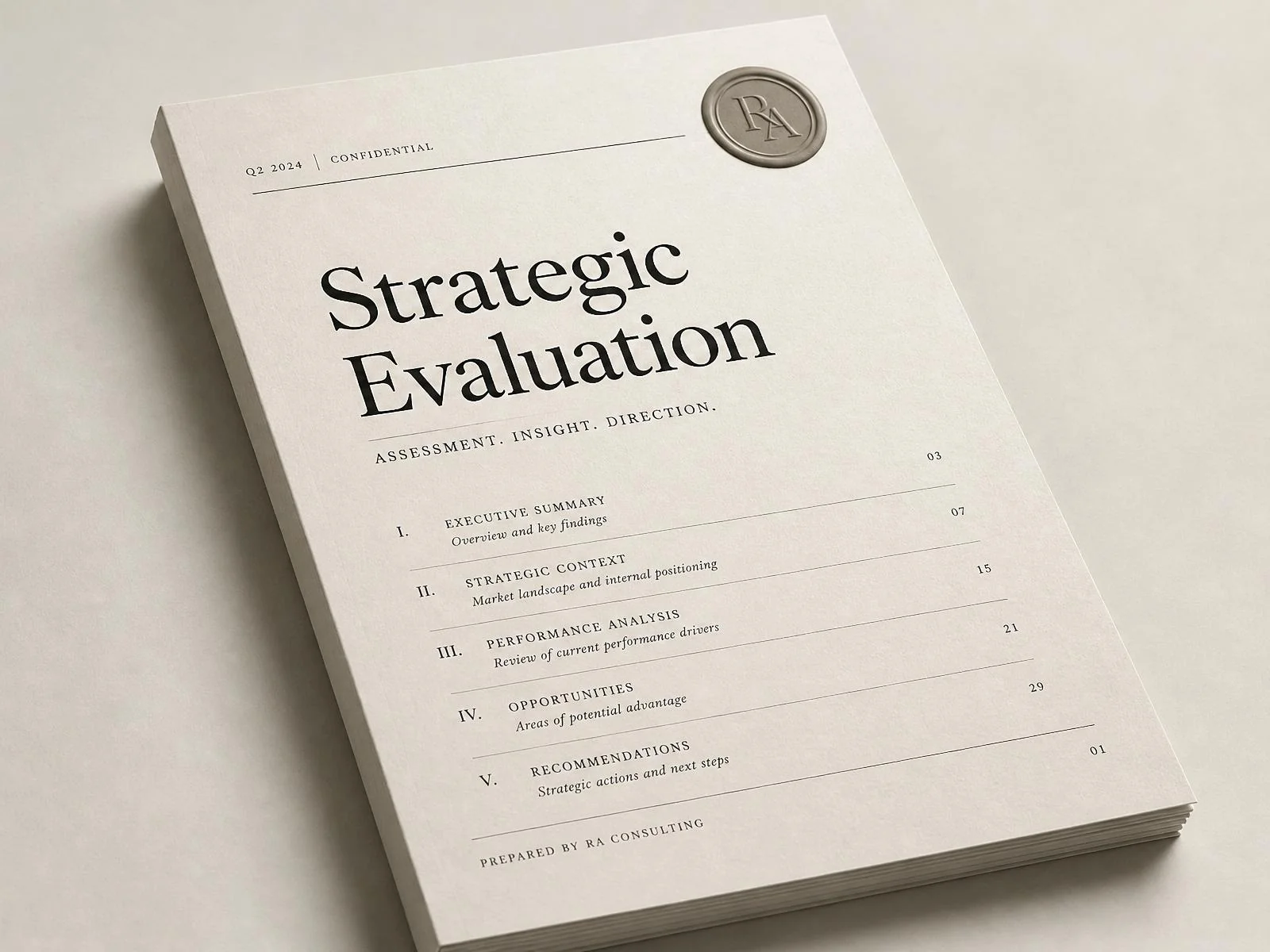
A Beryxa Evaluation · Delivered as a Written Document
§ 01 — If any of this sounds familiar
The situations founders describe to us.
Not problems in a deck. Situations founders actually carry — the ones that dominate the week, refuse to resolve in meetings, and quietly compound while the team keeps executing.
Unclear positioning
The product is strong, but the market keeps misreading what it is.
Confusing product direction
The roadmap is full. Which items compound, and which are momentum, is no longer obvious.
Inconsistent growth
Effort scales. Results don't. The reason is somewhere upstream of marketing.
Pricing uncertainty
Pricing has become a series of local guesses instead of a considered instrument.
Go-to-market uncertainty
Sales, marketing, and product each hold a slightly different definition of the customer.
Fundraising narrative questions
Meetings go well. The story doesn't quite compound in the way the numbers should let it.
Business model uncertainty
The model is working, but its shape may be quietly capping what the company can become.
One decision that refuses to become clear
A pivot, a hire, a market, a raise — a decision important enough to deserve outside judgment.
§ 02 — What Beryxa does
You describe. We read, think, and write.
A quiet, structured way to bring an independent mind to one important business decision — without meetings, workshops, or ongoing retainers. You describe what's happening. We do the rest.
- 01
You describe your situation
In your own words. A short written description of what is happening, what you are considering, and why it matters now.
- 02
We review it carefully
We read what you send — deck, site, metrics, and context. Personally, and usually within two business days.
- 03
We identify the real problem
The one underneath the one you described. Founders are rarely stuck for lack of ideas. They are stuck because the decision itself hasn't been named clearly.
- 04
We recommend the appropriate evaluation
You never have to diagnose yourself. We propose the evaluation that fits, share scope, pricing, and timeline, and — if we're not the right fit — we say so directly.
- 05
You receive a premium written evaluation
A structured document explaining what is happening, why, which assumptions matter, the implications, and the recommended direction.
§ 03 — Founder reflections
Founder reflections.
Real reflections from founders after working with Beryxa.
Aryan helped me think about Bookaro differently, particularly around positioning, messaging, and how to evaluate provider behavior rather than simply focusing on signups. Those conversations influenced several improvements I've made to both the homepage and the product.
Aryan was easy to work with and brought a thoughtful, structured approach to high-stakes business decisions. His ability to challenge assumptions, analyze options, and help clarify strategic direction was genuinely valuable. I appreciated his professionalism and insight throughout our collaboration.
§ 04 — Sample evaluation
Read what founders actually receive.
An anonymized excerpt of a real written evaluation — executive summary, strategic context, observations, reasoning, recommendations, and the questions we'd ask next. The structure, tone, and depth are representative of every engagement.
It reads like an internal strategic document, because that is what it is.
§ 05 — Inside a Beryxa evaluation
Inside a Beryxa evaluation.
A Beryxa evaluation is not a list of advice or recommendations. It is a written strategic judgment built around a specific business decision.
Every evaluation follows the same structure. What changes is the decision underneath it.
Document · Excerpt
Structure of every Beryxa evaluation
Beryxa · Strategic Evaluation
Confidential
- 01
Strategic Decision
The decision the company is trying to resolve — named precisely, in the language the business would actually use.
- 02
Evidence & Context
The available evidence and the assumptions surrounding the decision, separated cleanly so each can be examined on its own terms.
- 03
Competing Interpretations
The different conclusions the evidence could reasonably support — held side by side, without prematurely collapsing into one.
- 04
Independent Judgment
What the evidence has genuinely earned the company the right to conclude — and, just as importantly, what it has not.
- 05
Implications
What those conclusions mean before further commitment — for the decision itself, and for the decisions that will follow it.
Delivered as a written document. Read once, revisited for years.
§ 06 — How it works
From description to document.
Five transparent steps. You know exactly what happens after you describe your situation, what happens during the evaluation, and what you receive at the end.
- 01
Describe your situation
You send a short written description of what's happening — the decision you're carrying, the options you're considering, and why it matters now.
- 02
We review it
We read what you send personally, usually within two business days. If materials help — a deck, a site, recent metrics — send what you already have.
- 03
We recommend the appropriate evaluation
We identify the strategic problem underneath the surface question and propose the evaluation best suited to it.
- 04
Scope, pricing, and timeline are shared
Confirmed in writing. If we don't believe we're the right fit, we'll tell you directly.
- 05
The evaluation begins
We research, compare, reason, and write. You receive the complete written evaluation, followed by one round of written follow-up questions.
If we don't believe we're the right fit, we'll tell you directly.
§ 07 — The evaluations we offer
Strategic problems we most often evaluate.
These are the strategic surfaces Beryxa evaluates. You don't need to choose. After we review your situation, we recommend the one that fits — and if none of them do, we say so.
Every evaluation is a fixed-scope written engagement. Pricing depends on scope, complexity, and urgency, and is confirmed in writing before anything begins.
- 01
Positioning
When it fits
When the company needs clarity on what it has earned the right to be known for.
What it examines
How the product is understood, by whom, and against which alternative — and which of those the evidence actually supports.
- 02
Product
When it fits
When multiple product directions appear possible and the next commitment requires independent judgment.
What it examines
Which direction the evidence has genuinely earned, and which is momentum dressed as conviction.
- 03
Growth
When it fits
When growth signals exist but the company needs to determine which path deserves focus.
What it examines
Which loop, channel, or motion the evidence supports — and which is being sustained by effort rather than structure.
- 04
Pricing
When it fits
When pricing, packaging, or the model itself is on the table and the trade-offs require independent evaluation.
What it examines
Value, willingness-to-pay, and which model choice the evidence has genuinely earned the right to defend.
- 05
Go-to-Market
When it fits
When customer, channel, or market decisions require independent evaluation before further commitment.
What it examines
First market, first motion, first message — and which sequence the evidence actually supports.
- 06
Fundraising Narrative
When it fits
When the fundraising story is not converting the meetings the fundamentals should, and the narrative itself requires independent judgment.
What it examines
Whether the narrative logic, sequence, and claims are ones the business has earned the right to make.
- 07
Business Model
When it fits
When the shape of the business model may be capping what the company can become and the alternative requires independent evaluation.
What it examines
Structural limits, unit economics, and which alternative the evidence would support before it is committed to.
- 08
Decision Review
When it fits
When one consequential, hard-to-reverse decision is imminent and requires independent judgment before committing.
What it examines
The assumptions the decision rests on, the interpretations the evidence could reasonably support, and what remains genuinely unresolved.
- 09
Strategic Foundation
When it fits
When the strategic foundation forming inside the business needs independent examination before it is trusted to guide further decisions.
What it examines
Whether the foundation the company is operating from has genuinely earned the right to guide the decisions that will follow.
- 10
Validation
When it fits
When a planned validation must be independently evaluated before it is trusted to inform a consequential strategic decision.
What it examines
Whether the planned validation can produce decision-quality evidence, the conclusions it can legitimately support, and the uncertainty that will remain regardless of outcome.
- 11
Strategic Evidence
When it fits
When the decision matters but the evidence available internally is incomplete, and independent external evidence could materially change the judgment.
What it examines
What the combined evidence supports — including relevant external patterns, comparisons, and signals — and which strategic conclusion that evidence has genuinely earned.
§ 08 — Investment
Investment.
Every Beryxa evaluation is scoped based on the decision being evaluated, business context, and complexity.
Founder evaluations typically begin in the hundreds of dollars and scale based on scope.
Before anything begins, founders receive
- Evaluation scope
- Timeline
- Investment
No hidden pricing.
§ 09 — Why written
A different shape of consulting.
Traditional consulting is built around meetings. Beryxa is built around the document. The medium changes what the work can actually do — and how long it can continue to be useful.
Traditional consulting
- Meetings and workshops
- Slide decks and frameworks
- Advice that dissolves after the room clears
- Ongoing retainers and standing calls
- Strategy shaped by whoever speaks first
Beryxa
- Careful reading of your actual materials
- Independent thinking, uninterrupted
- A deep written analysis, delivered as a document
- A single fixed-scope engagement, then it ends
- A permanent record you can revisit for years
§ 10 — Patterns we've observed
What we notice, repeatedly.
Recurring strategic patterns observed while working with founders. No clients named, no results claimed, no numbers fabricated.
Strong products hidden by weak positioning.
Execution optimized before strategy is clarified.
Growth problems caused by messaging rather than marketing.
Small assumptions creating large downstream consequences.
Pricing that reflects internal cost instead of external value.
Teams too close to the problem to name it.
The best strategy buried under the most urgent problem.
Tactical questions asked before strategic ones.
§ 11
Founders don't lack information.
They lack distance.
Proximity is the founder's greatest asset and quietest liability. The same closeness that makes conviction possible also makes assumptions invisible. Frameworks harden. Language calcifies. The market you are describing to yourself is no longer the market outside.
A written evaluation reintroduces distance — the kind that comes from someone who reads carefully, thinks in slow prose, and has no stake in the outcome. That is Beryxa's role: independent, written, and structurally free of the incentives that quietly bend advice.
§ 12 — About Beryxa
About Beryxa.
Beryxa is an independent strategic evaluation practice for startup founders. Each engagement focuses on one important business problem and results in a carefully written evaluation.
We don't run sprints. We don't build roadmaps. We don't sit on standups, and we don't sell retainers. We read, we think, and we write — and we return a document that says what a careful outside reader with no political stake would say.
The written form is the product. It concentrates the work on the part founders benefit from most — being written to, at length, about the decisions they are already carrying.
§ 13 — Questions
Questions founders usually ask.
Do I need to know which evaluation I want?+
No. Describing your situation is enough. We identify the real strategic problem and recommend the evaluation that fits. Founders should never have to diagnose themselves.
What exactly do I receive?+
A structured written strategic report, typically 20–40 pages, delivered as a PDF. It contains an executive summary, strategic diagnosis, root causes, blind spots, risks, recommendations, next decisions, and questions worth answering. One round of written follow-up questions is included.
How much does it cost?+
Pricing depends on scope, complexity, and urgency. Every engagement is individually scoped after we've reviewed your situation. You'll receive scope, price, and delivery window in writing before anything begins.
How much information should I provide?+
Enough to understand the business and the decision. Usually a deck, website, recent metrics, and a short written description of the problem. We'll ask if we need more. Don't prepare materials you don't already have.
Do you implement recommendations?+
No. We evaluate; you decide and execute. Implementation stays with the team that owns the outcome. This is a deliberate boundary, not a limitation.
Can I submit an unfinished business?+
Yes. Early-stage companies and half-formed ideas are often where a written evaluation is most useful. We evaluate the thinking as it exists.
Is everything really delivered in writing?+
Yes. Every engagement is fully asynchronous and delivered as a document. No calls, no workshops, no Slack channel. The document is the work.
What happens if we're not the right fit?+
We'll tell you directly, and often point you toward what would be. Sending a description costs nothing and commits to nothing.
§ 14 — Describe your situation
Describe your situation.
Tell us what's happening. We'll review it, recommend the appropriate evaluation, and respond with scope, pricing, and next steps.
If we're not the right fit, we'll tell you directly.
Sending this costs nothing and commits to nothing. Personal reply, usually within one business day.
If something about your business feels unclear,
describe your situation.
We'll determine what deserves attention first, and recommend the evaluation that fits. If we're not the right fit, we'll tell you directly.